


A heavy afternoon storm in St. Petersburg can dump more water on your roof in one hour than some cities up north see in a month. Usually nothing happens, the yard dries out by dinner, and you forget about it. But a big rain is also the one moment when your house tells you the truth about itself. Knowing what to check after heavy rain — and doing it while everything is still wet — is one of the easiest ways to catch a small problem early, before it turns into a repair you did not plan for.
This is not a job for a ladder or a roof. Almost everything below can be done from the ground, from inside your house, and in about fifteen minutes.
Why Timing Matters So Much Right Now
The National Weather Service office that covers Pinellas County defines our rainy season as roughly May 25 through October 10, and it describes mid-September through early October as the “wind down” phase — the stretch where rainfall gets less predictable and tropical systems can still swing through (NWS Tampa Bay). So late September is a good time to run through what to check after heavy rain, while the ground is still soaked and any problem is still showing itself.
There is a second reason to move quickly. The EPA notes that if wet materials are dried out within 24 to 48 hours of a leak, mold usually will not get started (EPA, A Brief Guide to Mold, Moisture and Your Home). That short window is the whole reason a same-day look around is worth the trouble. A wet spot you find today is a towel and a fan. The same wet spot found in three weeks can be drywall, insulation, and a much longer conversation.
Start Outside — From the Ground
The first half of what to check after heavy rain happens outdoors. Walk the outside of the house while it is still dripping. You are not inspecting the roof; you are looking for where the water went.
- Gutters and downspouts. Is water pouring over the edge of the gutter instead of running through it? In older St. Petersburg neighborhoods with big oak canopies — Historic Kenwood, Old Northeast, parts of Crescent Lake — leaves and small branches fill gutters fast. An overflowing gutter dumps a concentrated stream right at your foundation.
- Where the downspout ends. If it empties two inches from the wall, that water is soaking the soil right against your house. You want it carried several feet away.
- Stains on the outside wall. Long dark streaks under a gutter joint or under a window usually mean water is running somewhere it should not.
- Soffits and eaves. Stand back and look up at the underside of the roof overhang. Dark patches, sagging panels, or drips coming out of the soffit are worth mentioning to a professional.
- Around the AC pad and water heater closet. Standing water where equipment sits is a problem on its own.
Never get on the roof, climb a wet ladder, or open an electrical panel to investigate. There is nothing you can learn up there that is worth the risk, and a professional can look at it safely.
Walk the Yard While It Is Still Wet
The yard is the part of what to check after heavy rain that most homeowners skip, and it is the most useful. Pinellas County is flat — really flat — and a lot of St. Petersburg sits at low elevation near Tampa Bay and the Gulf. Many lots here have very little natural slope, so water does not always leave on its own.
Look for puddles that sit next to the house rather than out in the yard. A puddle in the middle of the lawn is normal. A puddle hugging the foundation, hours after the rain stopped, means the ground is sloping the wrong way. Over time that keeps the soil under and beside your home saturated, which is how you end up with damp walls, buckling flooring, and a very good environment for termites.
Also check whether mulch or soil has washed into a pile somewhere. That tells you the path the water took. And if you have a septic system, soggy or unusually green grass over the drain field after a big rain is worth having looked at.
What to Check After Heavy Rain Inside Your Home
Come inside and go room by room. You are looking with your eyes and your nose.
- Ceilings. Look up in every room, especially corners and the spots under any roof valley or plumbing vent. A fresh leak often shows as a faint yellow-brown ring. Take a photo — if it grows after the next storm, you know it is active.
- Around windows and sliding doors. Run your hand along the bottom corners of the frame. Damp drywall, bubbling paint, or a soft spot in the sill means water is getting past the seal.
- Baseboards along exterior walls. Swelling, separation, or discoloration near the floor usually means moisture coming from outside or below.
- Under every sink and behind toilets. Not rain-related, but you are already walking the house — do it anyway.
- The smell. A musty, earthy smell in one closet or one corner of a room, when the rest of the house smells fine, is real information. Trust it.
If you want more detail on the quiet early warnings, we wrote about them here: 7 Small Signs of a Water Leak You Should Never Ignore.
Your AC Matters More Than You Think
After a soaking rain the air outside is loaded with moisture, and your air conditioner is the main thing keeping the inside of the house dry. The EPA recommends keeping indoor humidity below 60 percent, and ideally between 30 and 50 percent. An inexpensive humidity gauge from any hardware store will tell you where you stand.
If the house feels clammy, the windows fog, or the floors feel slightly tacky even though the thermostat says the temperature is fine, your AC may be cooling without removing enough moisture. Also glance at the drain line and the pan under the air handler. Water sitting in that pan means the condensate line is clogged, and that will eventually overflow into the ceiling or the closet floor.
Simple Things You Can Check Yourself
Here is what to check after heavy rain, start to finish. It takes about fifteen minutes, with no tools and no risk:
- Look at every ceiling in the house and photograph anything that looks like a stain.
- Feel the bottom corners of windows and sliding glass doors for dampness.
- Open cabinets under sinks and shine a phone light at the back corner.
- Check the indoor humidity with an inexpensive gauge.
- Look at the pan under the air handler for standing water.
- From the ground, look for water overflowing gutters and see where downspouts end.
- Walk the yard and note any puddle still sitting against the house.
- Take pictures of anything questionable, with the date, so you can compare after the next storm.
That is the whole homeowner list. Anything past that — walking a roof, opening an energized panel, crawling into a hot or unlit attic, pulling apart plumbing — belongs to someone trained and insured to do it.
When It Makes Sense to Bring in a Professional
Part of what to check after heavy rain is knowing when to stop checking and call someone. Reach out if you find a ceiling stain that has grown, a wall that stays damp after the house has dried out, a musty smell you cannot trace, or water that keeps pooling against the foundation storm after storm. Those are not emergencies, but they are not things that fix themselves either.
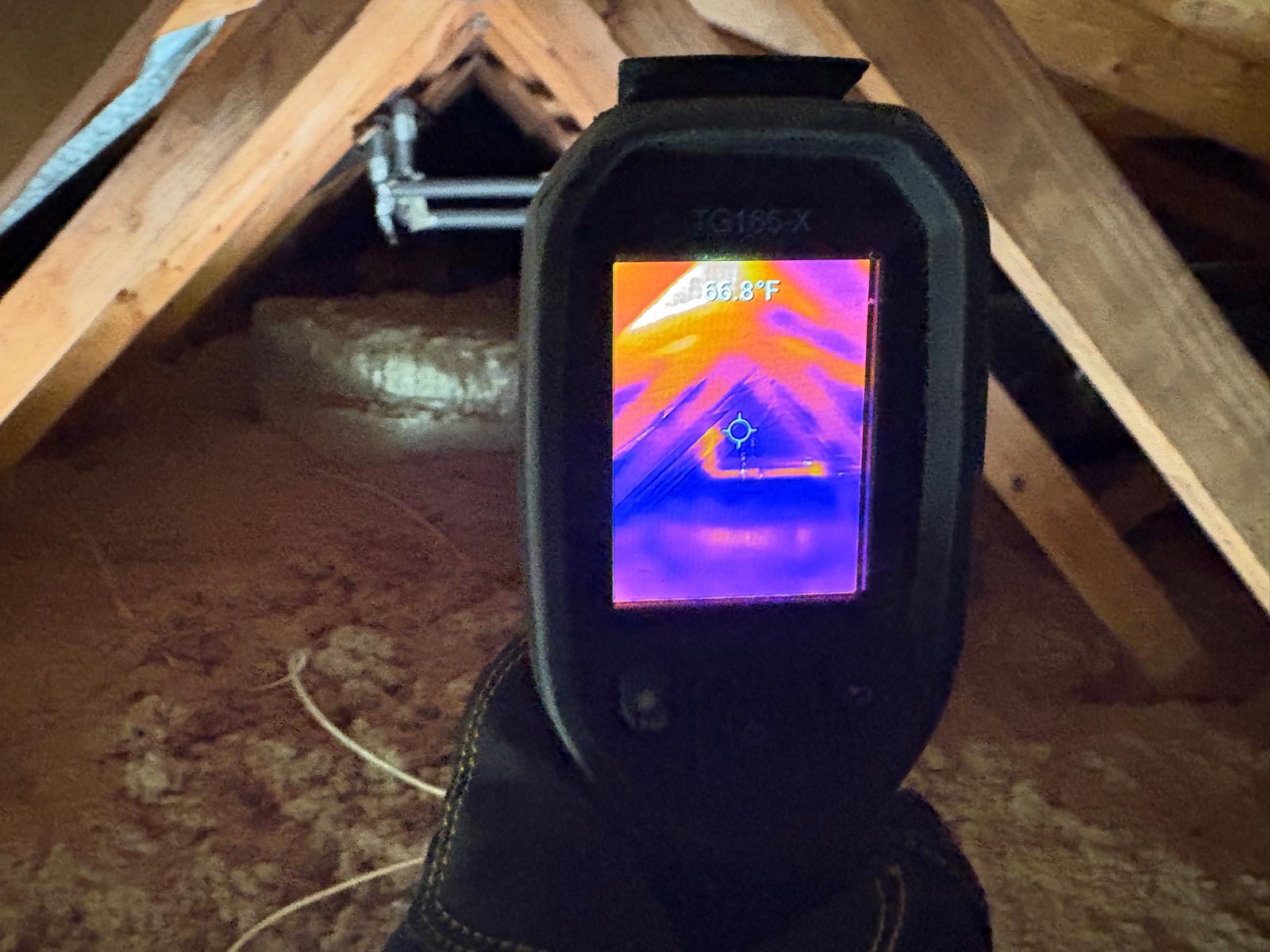
A professional can use tools you do not have. A moisture meter reads how wet a wall actually is behind the paint, and a thermal imaging camera can show temperature differences that point to water hiding inside a wall or ceiling. If there is already visible growth or a persistent smell, a mold inspection is the right next step rather than guessing.
For Realtors, this is a useful thing to pass along to clients in the weeks after a storm — especially buyers under contract who are wondering whether what they are seeing is normal or a real issue. An inspector’s job is to describe the condition of the property plainly, so the client and their agent can decide what to do with that information together.
Frequently Asked Questions
How soon after a heavy rain should I check my house?
Within a day, ideally the same afternoon. Run through what to check after heavy rain while the house is still wet. Wet evidence is easy to see and easy to dry. The EPA notes that materials dried within 24 to 48 hours usually will not grow mold, so the sooner you look, the simpler the fix.
Is a puddle in my yard after a Florida downpour a problem?
Not usually. A puddle out in the lawn that drains within a few hours is normal, especially with Pinellas County’s flat ground and high water table. The one to pay attention to is a puddle sitting directly against your foundation long after the rain stopped, or one that shows up in the same spot every single storm.
What does a brown ring on my ceiling mean?
It means water reached that spot at some point. It does not automatically mean you have an active roof leak — it could be old, or it could be a plumbing or AC condensation issue. Photograph it, date the photo, and see whether it changes after the next rain. If it grows or feels damp, have it evaluated.
Can a home inspection find a leak that is not visible yet?
Often, yes. Moisture meters and infrared cameras can flag damp areas behind finished surfaces that look perfectly normal to the eye. No tool sees through everything, but they frequently catch problems weeks or months before a stain appears.
Should I check for this before buying a house in St. Petersburg?
Absolutely — and if you can, visit the property after a rain. Drainage problems, overflowing gutters, and low spots next to the foundation are much easier to spot when the ground is wet than on a dry, sunny showing day.
Help With St. Petersburg and Pinellas County Homes
Knowing what to check after heavy rain gives you a real head start, but at some point you want another set of eyes and the right tools. Alex Home Inspection Services LLC, based in Bradenton, serves St. Petersburg and surrounding Pinellas County communities, along with Manatee, Sarasota, Hillsborough, Charlotte, and Hernando counties. We offer full home inspections, 4-point and wind mitigation inspections, sewer and drain camera scoping, water quality lab testing, and septic tank inspections, with reports delivered within 24 hours.
Florida license #HI-15079. If you are a homeowner with a question, a buyer under contract, or a Realtor whose client needs a clear answer about a property’s condition, we are happy to help. Call (508) 246-3465, message us on WhatsApp at (813) 510-9403, or schedule an inspection online.